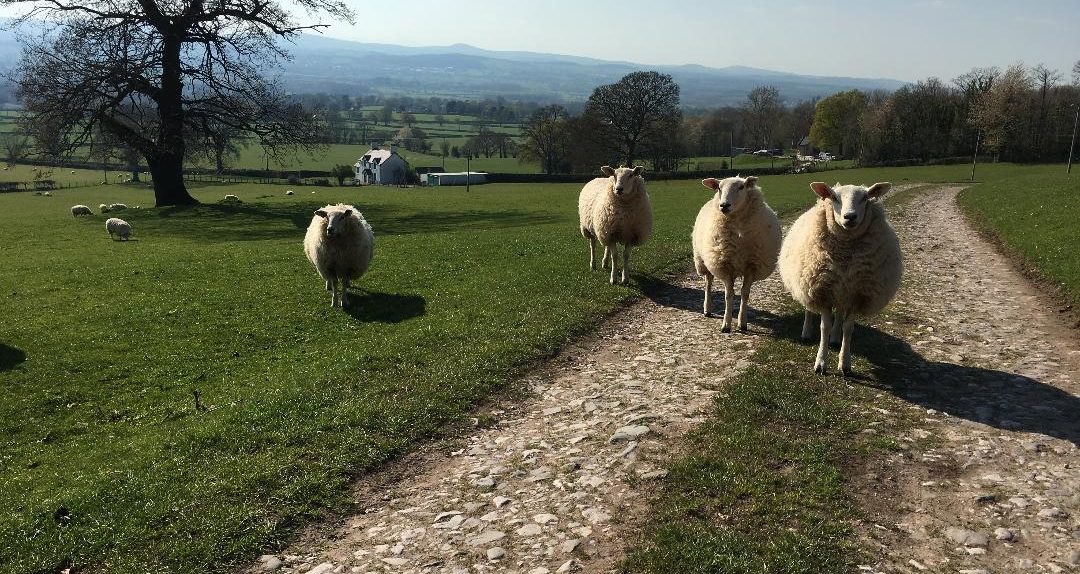
Our frosted hills and fields, for so long hushed in a quiet stillness of waiting, now sound with the tremulous bleating of new born lambs and the answering calls of their attentive mothers. Snowdrops have given way to bright drifts of daffodils, daylight stretches into lengthening hours, and winter begins to loosen its grip on the land.
Yet for those who work here, these first welcome signs of spring carry weight as well as wonder. Lambing marks the beginning of a new farming cycle. This is the busiest period in the calendar for sheep farmers, signalling weeks of early starts, late nights, and back-breaking work, a time when hope and anxiety are felt in equal measure.
Sheep Farming in North Wales
Sheep farming has shaped the landscape and culture of North Wales for hundreds of years. From the rolling pastureland of the coastal plains, through lush valleys, to the rugged upland farms of Eryri and the Clwydian Hills (Bryniau Clwyd), sheep are integral to the very fabric of the country, economically, visually, and historically. Many farms are family run, with hard-won knowledge and wisdom passed down through the generations.
Great care is taken to monitor the pregnant ewes as they approach lambing time. Most commercial sheep farmers in the UK have their ewes scanned, especially those with lowland, or more intensively managed, flocks. This allows farmers to know how many lambs each ewe is carrying, assisting with feed planning, monitoring for multiple births, and reducing lamb losses.
However, in more traditional hill or upland farms, like those in parts of North Wales, some farmers still rely on decades of experience, reading subtle changes in behaviour and movement, especially where terrain makes scanning logistically difficult, or where flocks are smaller and shepherds know their ewes well. Where there are concerns about a ewe’s wellbeing, she may be brought into a sheltered pen so she can be closely observed and helped if necessary. Elsewhere, lambing takes place out on the hillsides, where farmers and shepherds make regular rounds, often in harsh weather, to ensure all is well.
First Moments
The moments immediately after birth are crucial. A ewe will instinctively call to her lamb, urging it to get up and feed. She licks her youngster thoroughly, learning its unique scent, vital in allowing her to recognise her own lamb within the wider body of the flock. This vigorous licking also stimulates the lamb’s circulation, warming its small body into life. It also encourages milk flow in the ewe, ensuring that her youngster receives its first, most vital nourishment: colostrum. Rich and golden, this first milk is not simply food, but protection, dense with antibodies and nutrients, strengthening the lamb’s fragile body and helping to guard it against disease in its earliest hours.
Occasionally, however, complications during birth may leave a lamb orphaned, or a ewe might reject her lamb. When this happens, farmers step in as surrogate carers. Lambs are bottle-fed in the shelter of a barn, quickly learning to recognise the sound of footsteps, the creak of a door, or the familiar rattle of a feed bucket.
Communication, Protection and Independence
Ewes communicate with their young in low, rhythmic murmurs – soft “mmmeh… mmmeh…” and “errr-mm…” sounds that rise from the throat rather than the chest. These warm, intimate calls carry a soothing quality, used to reassure, guide, and maintain contact with the lambs. To them, it is a signature voice, instantly recognisable, calm, familiar, safe. Over greater distances, the call strengthens, becoming clearer and more resonant, a firmer, strident “maaa-eh” that carries across the field.
Ewes are fiercely protective, keeping their lambs close and responding instantly to any perceived threat. But lambs grow quickly, and within days they begin to test their legs, leaping, bounding, and running with sudden bursts of exuberant energy. Curiosity soon outweighs caution, and they venture further from their mothers, exploring their world with tentative – and sometimes misplaced – confidence. Despite these early shows of independence, the bond remains strong. A distressed or lost lamb will bleat loudly, and its mother will answer in return, calling it back to safety.
As the weeks pass, the intensity of lambing gradually eases. Pens empty and fields fill. The rush of sleepless nights fades, replaced by steady routine and measured checks. For farmers, this is a period of quiet reflection, a moment to catch their breath and take stock of the season.
The Never-Ending Cycle
The sight of newborn lambs is more than a sign that spring has finally arrived. These small creatures, finding their unsteady feet on cold, wet grass, belong to a way of life rooted in the valleys and uplands of North Wales for centuries, a life shaped by stone walls and field boundaries, by wind-scoured ridges and sheltered folds of land.
They are born into a landscape known intimately by the men and women who work it: people who can read the weather in the sky, whose hands are lined and worn by years of labour and toil. Their days begin early and end late, measured not by clocks but by light and dark, and the rhythms of the seasons.
Lambing time may be a renewal of flocks and of livelihoods, but it is also something deeper: a re-affirmation of the enduring relationship between people, their animals, and the land they share.