The Theatre of Lightning
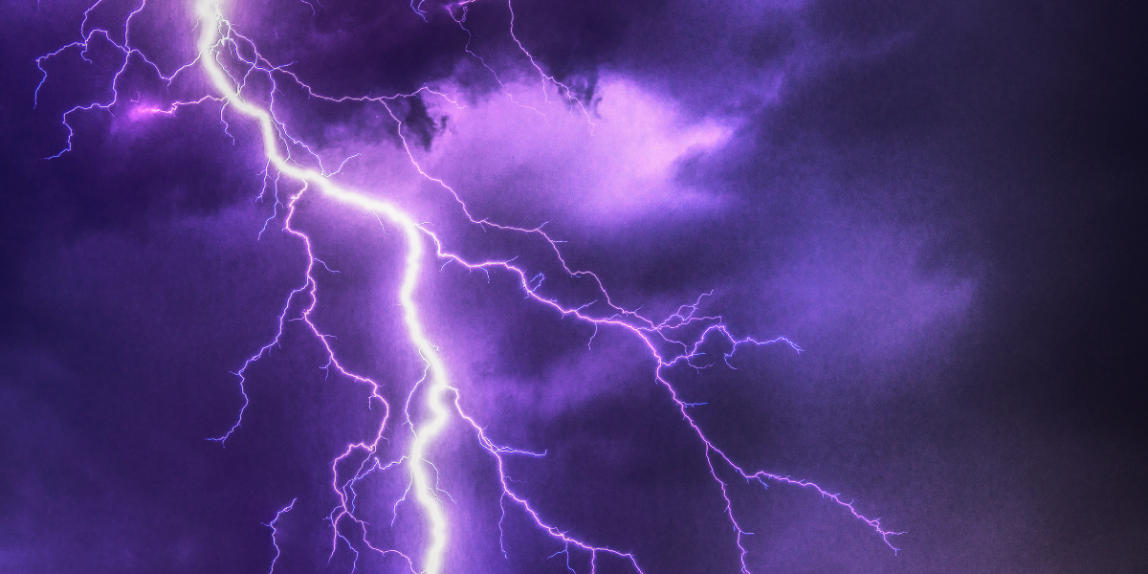
We had been making our way to bed when the first flash of lightning stopped us. Arriving on the back of a yellow weather warning for a heatwave in May, the storm swept in late on an airless Wednesday night, tearing the sky into great white seams and illuminating the Clwydian hills with sudden shocks of light, before the darkness swallowed them whole again. Energised, we sat transfixed, curtains pulled wide, the window a theatre frame for something vast, powerful, and magnificent.
What we were watching begins far above, inside towering cumulonimbus clouds, anvil-headed giants that can reach twelve miles into the sky. There, ice crystals and water droplets collide in furious updrafts, creating enormous electrical imbalances, a tension that builds exponentially, until the energy finally breaks.
Sometimes it is sheet lightning, silent, diffuse, illuminating entire cloudbanks from within, pulsing and diaphanous. But when the charge finds a path to ground, it becomes something far more violent. First, an invisible channel, known as the ‘stepped leader’, forges a path earthward. The moment it connects, the return stroke explodes at around a third of the speed of light, creating temperatures five times hotter than the surface of the sun and producing the brilliant flash we see as lightning. A single bolt can carry billions of joules of energy, the equivalent of a tonne of TNT detonating in an instant.
The Sound and the Fury
If lightning is the spectacle, then thunder is the feeling. When a bolt strikes, it superheats the surrounding air in microseconds, causing it to expand faster than the speed of sound. The resulting compression wave rolls outward as thunder: a sharp crack, almost simultaneous with the lightning flash when the strike is near, a long resonant rumble when further away. At close range it has an almost physical presence, a concussive quality – sound as force.
But beneath the frequencies we can hear, there is infrasound, vibrations too low for the ear to detect, but which are felt by the body. Researchers believe that sound at this frequency can trigger unease, disorientation, and even the unsettling sense that something malevolent is present, beyond the edge of vision. It may explain why storms have always carried a supernatural charge, why thunder gods appear in the mythologies of almost every culture on earth – Thor, Zeus, Indra, Taranis. Something in us responds to thunder the way our ancestors did, sheltering, listening, and waiting.
Then comes the rain. The first drops fall, plump, heavy, and deliberate, before the storm builds to a full percussive fury; staccato strikes on window panes, a relentless tattoo on tarmac, a hollow clattering on corrugated iron, a deep, steady, drumming on grass and soil. Then, gradually, the drumming softens, the thunder fades to a distant murmur and the storm subsides, its last light flickering somewhere over the hills. Silence returns, punctuated only by the delicate pizzicato of water dripping from leaves and gutters.
The Blood of Immortals
After the storm comes the smell of rain on the earth, at once immediate and ancient. Known as petrichor, the term was coined in 1964 by two Australian scientists, Isabel Joy Bear and Richard Grenfell Thomas, from the Greek words petra (stone) and ichor, the fluid that flows through the veins of the gods.
The science is as intriguing as the name. Petrichor is not a single scent but a symphony of chemical reactions. It begins before the rain arrives. Ozone, formed when lightning splits oxygen molecules high in the atmosphere, is carried down to earth ahead of a storm, lending a clean, electric tang to the air. When the first raindrops strike the ground, volatile plant oils trapped in clay and porous rock are released. At the heart of it all is geosmin, produced by bacteria living in the soil, and detectable by the human nose at concentrations as low as five parts per trillion, a sensitivity likely honed by evolution, since the compound signals the presence of water.
With the clamour and the rain now gone, I step into the garden, sleep abandoned. The grass is wet, the air cool and still. Above the hills, the last of the clouds are moving east, and stars are beginning to show through. I breathe in the smell of the earth.
Our ancestors raised gods from thunder and lightning. But for this, the smell of rain on earth, we have found something quieter: not a god, but a name borrowed from stone, and the blood of immortals.
© Sonia Goulding 2026